
Jaw Crusher Configuration Matching Guide
Classic Crushing Line Solutions for Different Materials
In aggregate production and mining projects, a well-designed jaw crusher configuration plays a key role in production efficiency, product quality, and long-term operating cost.
Compared with focusing only on a single machine, selecting the right crushing and screening combination allows the entire production line to better match real working conditions.
This article introduces two proven and widely used jaw crusher production line solutions, designed for limestone and medium-to-high hardness materials.
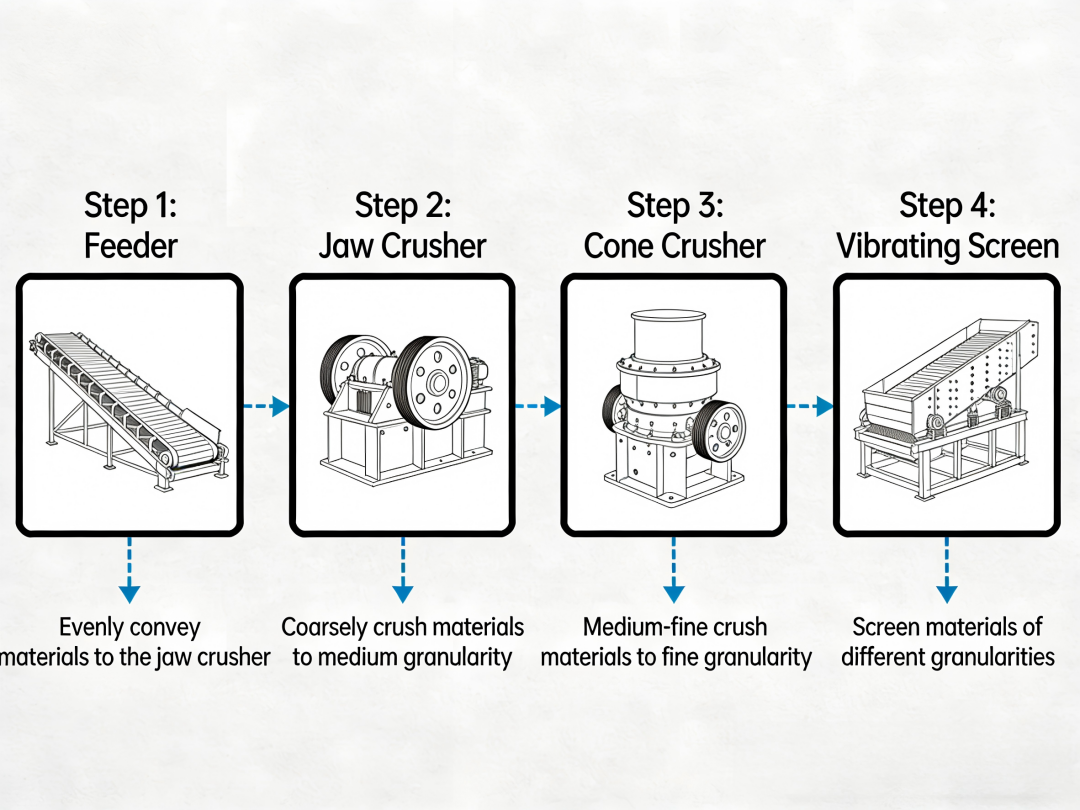
Solution 2: Feeder + Jaw Crusher + Cone Crusher + Vibrating Screen
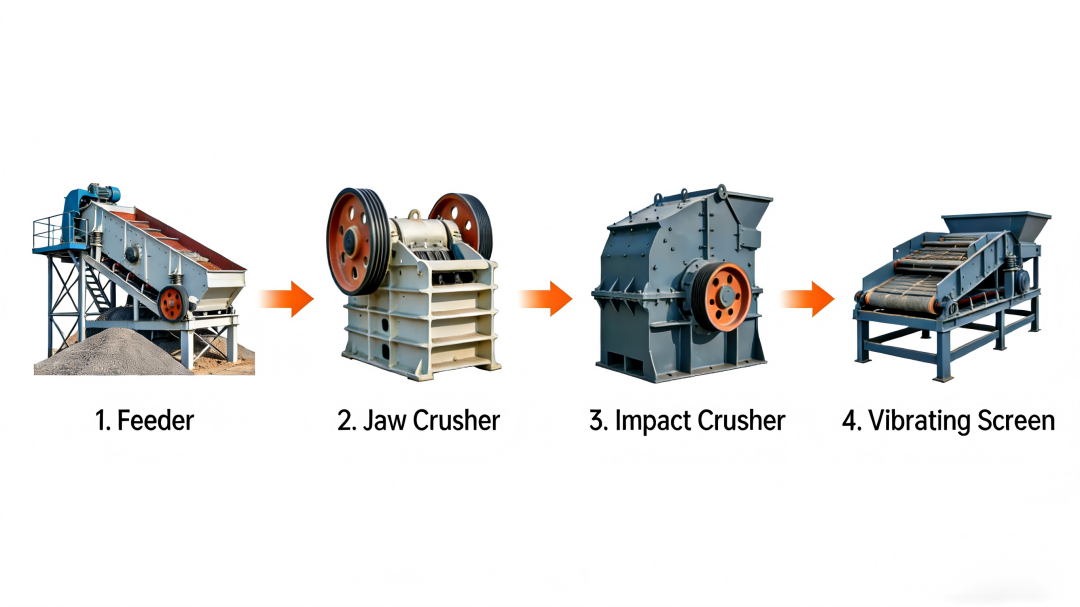
Mainstream Limestone Crushing and Shaping Solution
This configuration is one of the most commonly used solutions for limestone and medium-hard materials.
In this setup, the jaw crusher performs efficient primary crushing, while the impact crusher handles secondary crushing and shaping. The combination produces aggregates with excellent particle shape and well-controlled gradation, making it suitable for applications with strict quality requirements.
This solution achieves a good balance between:
Initial investment cost
Energy consumption
Production efficiency
Final aggregate quality
As a result, it remains a mature and economical choice for limestone crushing.
Typical applications include:
Building construction
Road and bridge projects
Concrete batching plants
Solution 2: Feeder + Jaw Crusher + Cone Crusher + Vibrating Screen
Proven Solution for Medium to High-Hardness Materials
This configuration is designed for granite, basalt, and other highly abrasive materials with Mohs hardness typically ranging from 6 to 8. It is a classic choice for mining operations and large-scale aggregate production lines.
The jaw crusher handles coarse crushing, while the cone crusher performs secondary and fine crushing using the laminated crushing principle, which effectively reduces flaky and elongated particles (usually controlled below 10%) and ensures stable product gradation.
By adjusting the cone crusher cavity type or the vibrating screen mesh size, the system can flexibly produce different aggregate sizes to meet various downstream requirements.
Typical applications include:
Building and infrastructure projects
Railway ballast production
Water conservancy and hydropower works
Ore beneficiation pre-treatment
How to Choose the Right Jaw Crusher Configuration
When selecting a jaw crusher configuration, users should focus on:
Material hardness and abrasiveness
Required production capacity
Finished aggregate shape and grading standards
Project duration and operating intensity
A well-matched configuration often delivers higher efficiency, better product quality, and lower long-term cost than simply choosing equipment based on price.
FAQ
Q1: What is the most common jaw crusher configuration?
The most common jaw crusher configuration is feeder + jaw crusher + secondary crusher + vibrating screen.
For limestone and medium-hard materials, an impact crusher is usually used as the secondary crusher, while a cone crusher is preferred for granite and other high-hardness materials.
Q2: Which configuration is better for limestone crushing?
For limestone crushing, the jaw crusher + impact crusher configuration is widely used.
It offers high crushing efficiency, excellent particle shape, and balanced investment and operating cost, making it suitable for construction and concrete aggregate production.
Q3: Why choose a cone crusher instead of an impact crusher for hard stone?
Cone crushers use the laminated crushing principle, which is more suitable for hard and abrasive materials such as granite and basalt.
They produce less flaky particles, have longer wear part life, and provide more stable output under high-load conditions.
Q4: Can one jaw crusher configuration produce different aggregate sizes?
Yes. By adjusting the cone crusher cavity type or vibrating screen mesh size, a jaw crusher production line can produce multiple aggregate sizes to meet different application requirements.
Q5: What factors should be considered when selecting a jaw crusher production line?
Key factors include:
Material hardness and abrasiveness
Required capacity
Finished aggregate quality standards
Project duration and daily operating hours
Maintenance and operating cost
Selecting the right configuration helps reduce downtime and improves long-term economic performance.
Q6: Is a jaw crusher configuration suitable for mining applications?
Yes. Jaw crusher configurations using jaw crusher + cone crusher are commonly used in mining projects, especially for ore crushing and beneficiation pre-treatment, due to their high capacity and durability.